
Why the plan belongs between scope and price — and how a firm's existing AI investment can help build and manage it.
Every firm has a version of this conversation.
It's month four of a matter. The engagement is running hot — not catastrophically, but enough that someone in finance has flagged it. Someone asks the reasonable question: how did we get to the original number?
And nobody can answer in detail.
Not because the people involved were careless. Quite possibly the opposite. The estimate may have been built with real rigor — comparable matters pulled for the right practice group, filtered to the right jurisdiction, weighted toward the ones this partner actually ran, banded for a deal roughly this size. That's a defensible process, and firms that do it well are doing something genuinely skilled.
The problem is what came out the other end. A number came out. And a number, however carefully derived, can't tell you much four months later when the shape of the matter has changed.
Not just producing a number. Not just storing a number.
Legal pricing gets treated as an accuracy problem. Firms respond by improving their estimating — better comparables, tighter filters, more sophisticated rate models, and lately AI to mine the history faster.
All of that helps. None of it addresses the actual failure, which isn't that the number was wrong. It's that a number is all anyone was left holding.
An estimate is a conclusion. A plan is a structure. The difference only becomes visible when something moves — and on any matter of consequence, something always moves. When it does, a conclusion gives you nothing to work with. A structure tells you which assumption changed, what it affected, and what your options are.
Most systems in this space produce a number, then store the number. What matters is everything around it: the scope that justified it, the plan that expressed it, the reasoning that produced it, and the ability to compare all three against reality as the matter runs.
You can start budgeting on day one
A firm does not need plans, scoping libraries, work packages, or AI to get value from Planning Blox. The core product does what a matter budgeting and management system has to do, from the first week you are live:
- Budgets built top-down or bottom-up, structured by phase, task, duration, or user-defined blocks
- Real-time budget-versus-actual tracking, drilled by phase, task, timekeeper, or practice group
- Threshold alerting at matter, client, and practice group level
- Portfolio views aggregating any number of matters
- Direct integration with Elite and Aderant, so actuals flow in without manual reconciliation
- Full support for alternative fee arrangements
Plenty of firms adopt Planning Blox this way and run it as a budgeting and reporting platform indefinitely.
But the firms getting the most out of it add one layer underneath the budget. That layer is the plan.
The plan is the missing layer
A plan isn't valuable simply because it describes the work more thoroughly. In a pricing context, its real value is that it gives the firm something a budget can be derived from.
If the plan sets out the work to be done, the expected quantities, the effort required, who will do it, and the assumptions behind all of that, then the financial model has something concrete to work with. Effort translates into cost and price through the firm's rates, staffing model, leverage targets, and pricing rules.
The budget becomes an output of the plan (and pricing decisions) rather than a number the plan is later asked to explain.
That sequence is the whole idea:
Scope → Plan → Effort → Staffing → Budget → Manage
None of which constrains the commercial arrangement. The budget can still be built top-down when that's the right approach with a particular client. The matter can still run as a fixed fee, a capped fee, a phased arrangement, or straight hourly. What changes is that the firm has a structured view of the work sitting underneath the financial model, instead of relying on the number alone.
Four ways to build a plan
There isn't one right way to get there. The right starting point depends on what the firm already knows about the work.
Option 1 - Start with historical comparables. Your pricing team's existing practice, with the analysis performed in the firm's own AI. Planning Blox warehouses the matter and billing data; the AI connects to it and identifies relevant matters by billing partner, practice, jurisdiction, size band, and complexity — the dimensions your team already uses. The comparables selected, the distinct facts that made each relevant or different, and the reasoning behind the selection all flow back and attach to the matter.
Option 2 - Start with defined work packages and firm rules. Where the firm has repeatable experience, work can be defined in units carrying effort profiles and staffing assumptions, with rules for determining quantities. Your firm authors those rules in Planning Blox and cross-references them to scoping questionnaires. When a completed questionnaire comes back, the AI acts as the calculator — applying your rules and exploding them into a plan.
Option 3 - Start with an AI conversation. For genuinely novel work, there may be no useful precedent and no established work-package library. Lawyers, pricing professionals, and the firm's chosen AI can work through the matter conversationally: what's known, what's uncertain, which workstreams are likely, which assumptions need testing. What emerges is a complete scope and plan, flowing back into Planning Blox as structured records.
Option 4 - Start from scratch. Sometimes there's no useful comparable, no work-package library, and no need for AI at all. A pricing professional, lawyer, or LPM builds the scope, assumptions, optional project plan, and budget directly. The planning capability stands on its own.
In practice these combine. A complex matter might use comparables to establish the overall envelope, rules to build the discovery phases, manual planning for a known but unusual workstream, and a conversation with the firm's AI for something with no precedent.
Rules handle what's known. Conversation handles what isn't. Judgment handles what neither can.
Scope is the foundation
Underneath all four approaches sits the scoping.
The questions your lawyers already ask at intake are usually quite good. How many custodians? What's driving the timeline? How many jurisdictions? What's the client's tolerance for a protracted dispute? The problem is that those questions live in a phone call, an email, or someone's notes, and the answers evaporate.
Planning Blox houses them as structured questionnaires by matter type, so the firm can build a scoping library around the questions that actually matter to its practices — capturing structured answers and narrative responses alike. Where a firm is starting from nothing, its AI can draft those questionnaires from the practice group's own language and existing matters, which turns library-building into a review exercise rather than a committee project.
Some of the most important scoping information is inherently narrative, and no lookup table parses it. AI is genuinely useful here: it interprets the answer and proposes the qualifier values it appears to imply, subject to human review.
The ordering matters. Staffing standards, leverage targets, seniority floors, complexity multipliers, and client commitments in outside counsel guidelines are firm decisions, authored and governed by the firm — not quietly invented by a model. The AI interprets. The firm's rules decide. What the system removes is manual labor, not judgment.
What gets preserved
This is what separates a planning system from an estimating tool, and it's worth noting what gets kept.
The detailed scope — questionnaire responses, including narrative answers, attached to the matter and available to anyone who needs to understand what was assumed.
The project plan — phases, tasks, durations, dependencies, staffing assignments. Viewable as a work breakdown or as a Gantt chart, which matters more than it sounds: a Gantt is the version a client, a partner, and a general counsel can all read without translation.
How you got there — which comparables (if any) were selected and why, which rules were applied, which assumptions were made, and where judgment was required.
The budget, derived from all of it and traceable line by line.
The immediate benefit is defensibility. When a client benchmarks you in a panel review, when an outside counsel guidelines audit asks why a matter was staffed a particular way, when a partner asks why a similar engagement was priced differently last quarter — the answer exists, and it doesn't depend on whoever built it still working at the firm.
The longer-term benefit is subtler. Historical matters record what was spent, not what was assumed. You can see a matter ran 1,400 hours; you can't see it was scoped for eight depositions and finished with nineteen. Once the reasoning is retained alongside the outcome, your comparables carry their assumptions with them. History becomes a record of decisions rather than a record of results.
Managing the matter, not just the number
The standard model of matter management is variance reporting. You set a budget, watch actuals accumulate, and at some threshold someone gets an alert. The report is accurate and describes a symptom rather than a cause.
Being twelve percent over budget is not a finding. It's a consequence, and a late one, because dollars are the last thing to move. The scope changed weeks earlier. The staffing shifted before that. By the time the number is out of tolerance, the decisions that put it there are behind you, and the only remaining lever is who absorbs the difference.
When the plan and scope are stored alongside the financial data, the comparison runs continuously against more than the total. A phase tracking behind on task completion is a signal weeks before it registers financially.
Eleven depositions instead of three isn't initially a budget problem. It's a scope change with a budget consequence. Framed the first way, you have an overrun to explain. Framed the second, you have a decision to make — renegotiate scope, adjust leverage, absorb the additional work deliberately as a relationship investment, or trigger the change-order provision sitting unused in the engagement letter.
The point isn't to prevent scope from changing. Legal matters change. The point is to see the change while meaningful decisions are still available.
That's the ambition behind no surprises — not for the client, not for the partner, not for the LPM team.
Reporting a client can actually read
Most matter reporting is a number and a variance: here's the budget, here's the spend, here's the gap.
A report built from a plan shows the work itself — phases and their status, what was scoped and what changed, where the matter sits against the original plan, and the financial consequence. Branded to your firm, generated on demand or on a schedule.
That changes the client conversation. Without a plan, a difficult update becomes an apology: we've exceeded the estimate, followed by reconstruction both parties recognize as reconstruction. With a plan, it's a status report: we're tracking to plan across five of six phases; discovery expanded when the additional custodians came in — here's the assumption that changed, here's what it added, here's the revised path. Same overrun, entirely different relationship, because the client can see the reasoning rather than being asked to trust it.
It also changes what clients push back on. Presented with a number, the available conversation is about rates and margin. Presented with a plan, clients push back on scope — do we need the second-level review, can we narrow the custodian list, are we comfortable accepting more risk here. Those are productive conversations about the work, and firms generally do well in them.
Where your AI fits
The financial core described earlier runs with no AI involved. Among the four planning routes, building from scratch involves none either. The other three put your firm's AI to work in different ways — and the important word is your firm's.
Planning Blox is designed to leverage the AI investment a firm has already made. Your people work in the environment your firm selected and your risk function approved. Planning Blox supplies the structured matter context, data, and planning framework that AI needs to do useful work, and receives the scope, plans, and reasoning it produces. There's no second AI to license and no proprietary chat window for anyone to learn.
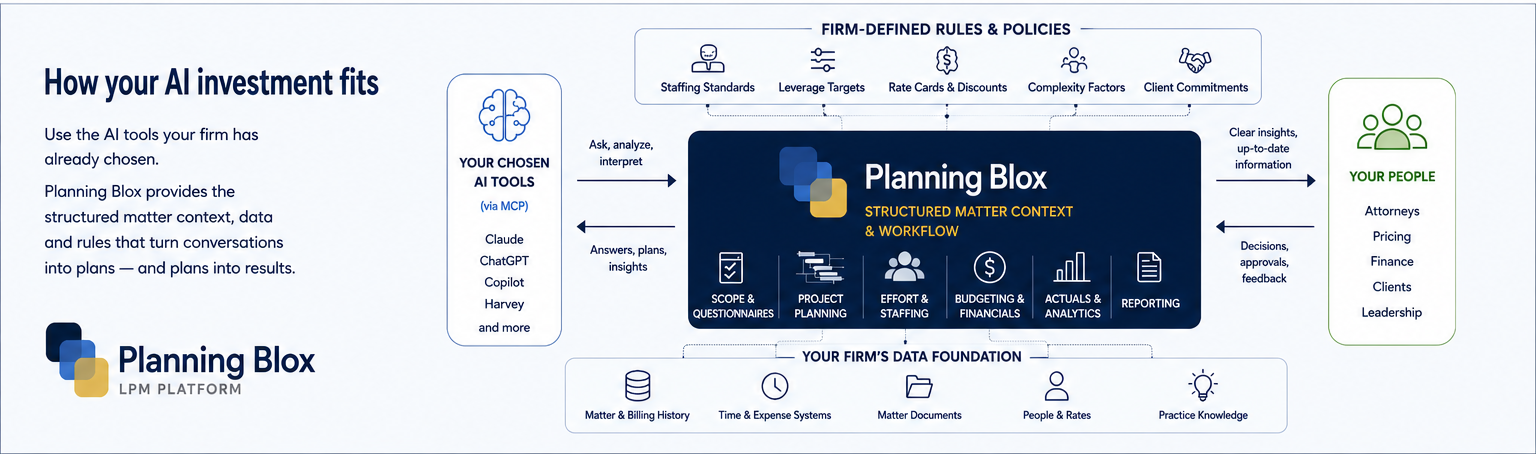
That's where MCP becomes interesting. Rather than asking a general-purpose AI to estimate a legal matter from a blank screen, MCP lets the firm's chosen AI work with the firm's Planning Blox information and structures. The conversation happens in the firm's own AI environment; the resulting scope, plan, and structured information flow back into the matter. The AI becomes a useful interface to the firm's matter-planning system rather than another system of record.
One AI capability worth calling out, because it's easy to underrate. Billing history records cost and says nothing about whether the matter went well. A matter that ran $840,000 and settled favorably in month five and one that ran $840,000 and lost at trial in month fourteen are identical data points in a rate analysis and completely different guidance. Where your AI can reach adjacent matter information for context and outcomes, the question changes from what did matters like this cost to what did the matters that went well cost, and how were they staffed. No comparables spreadsheet answers that.
Getting there
None of this requires a transformation program, and none of it asks a pricing team to abandon what it's already good at.
The raw material exists — in the comparable-matter work your team performs, in the questions your lawyers ask at the start of every matter, in your billing history, and in the accumulated judgment of people who have run this kind of work many times before. Increasingly it exists in the firm's AI investment too. The gap is that scope, plan, budget, and actuals live in different places and get reconciled by hand, occasionally, by whoever has time.
Planning Blox closes that gap. Budgeting, tracking, alerts, and client reporting from day one. A structured way to capture scope and build plans when you want them — from comparables, work packages, conversation, manual planning, or any combination. And your own AI brought into the process wherever it adds value.
It's in use at many of the largest firms in the world. The result isn't another estimate. It's a matter that can be understood, explained, and managed from the assumptions that created it through the work that actually gets done.
Because the estimate was never really the hard part. The hard part was retaining enough structure to manage what happened next.